
What are Agape’s Camps?
The camps held at Agape provide a space for discussion and constructive exchanges and last from one week to a maximum of ten days. There are three main types of camps: camps for minors, gender camps, and international camps. Each year a camp is centered around a different current theme that is developed through various tools: non-formal education activities, debates, plenary sessions, group discussions, expert speeches, workshops, simulation games, and more.
The camps are also an opportunity to spend time surrounded by the nature of Prali, to meet people coming from different countries and with different backgrounds, to have fun, and to rest. Participating in a camp at Agape means to take a part in community life characterized by sharing common spaces and everyday life, but also personal experiences.
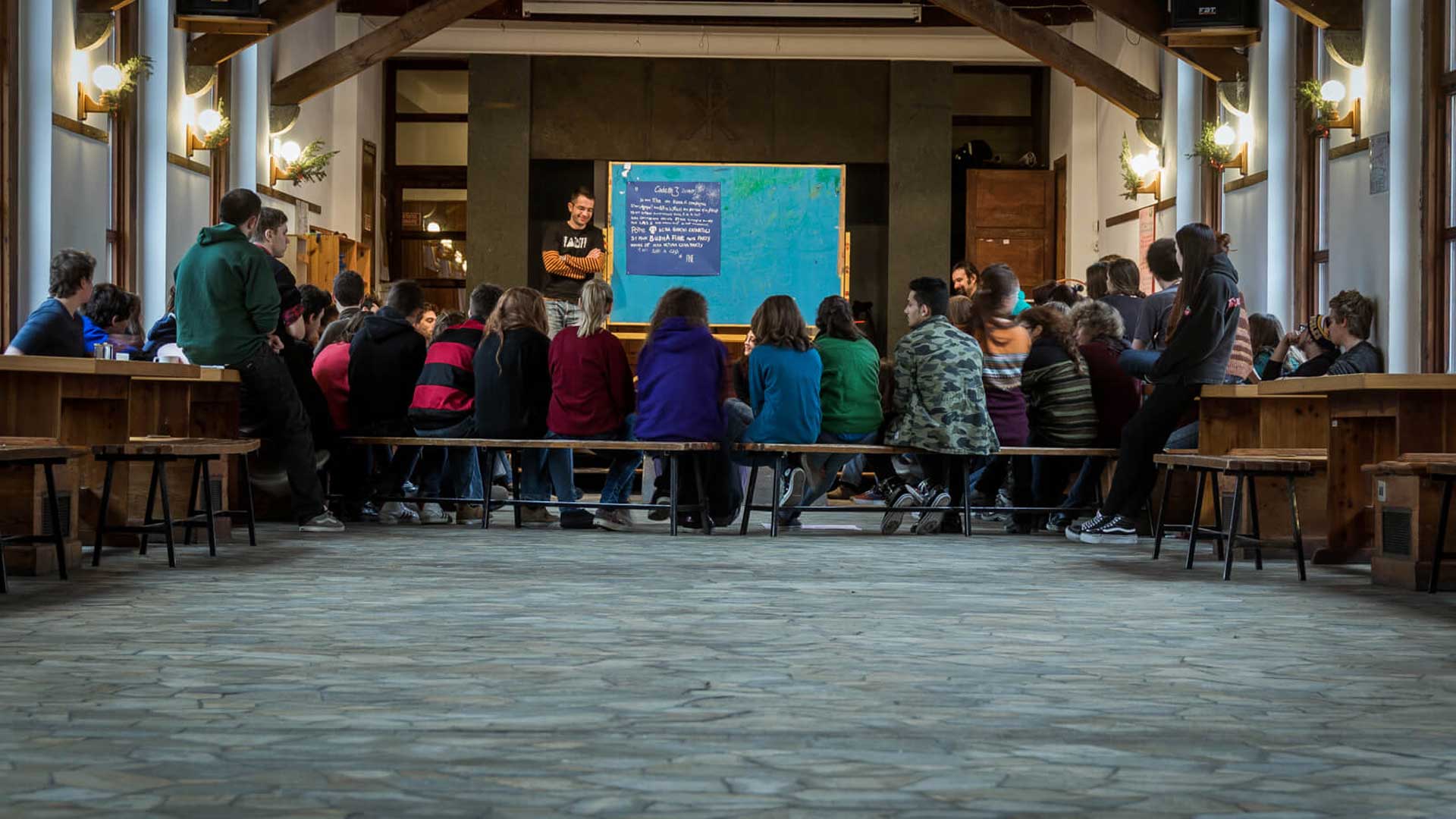
Program
2025
| 26 Dec - 1 Jan | Cadetti/e 3 | Sguardo oltre i muri |
2026
Daily Schedule
- Wake up
From 8:00 to 8:30 – Breakfast - Morning activities
Mid-morning break: the bar is open - Lunch
At 12:30 or 13:00 followed by a short break - Afternoon activities
Mid-afternoon break: the bar is open - Dinner
At 19:30 or 20:00 followed by a short break - Evening activities
Evening activities end around 23:00: the bar is open
Camps at Agape always follow the same order of activities with some possible time schedule variations.
The camp activities follow a common thread and analyze the central topic from different point of views. Each activity is not an end in itself, but delivers a message and advances the development of the main theme. There are different types of activities that are adapted to suit the different camp participants: the camps for minors utilize games and activities that convey the themes in a more implicit way, while the adult camps offer debates, lectures or presentations. All camps use non-formal education techniques: even adults are involved in activities such as simulation games or creative workshops that challenge them in different ways.
The evenings foresee more light-hearted activities such as watching films, singing, dancing and get together games. All camps include a hike in the mountains of Prali, which often ends with a bonfire once back at Agape.
The meals take place in a common area. Everyone eats together at tables for ten and shares food. The Resident Group plans the menu each week trying to have seasonal and possibly 0-km products. Meat is limited to once every two days.
Agape often offers a closing moment of the camps that refers to the Christian origins of the Center, which is more spiritual and religious. It is not obligatory to participate, but it is important to keep in mind that this is an integral part of the history and life of Agape.
Each camp ends with a final party to celebrate the moments experienced together, and which is also an opportunity to share the results with the Resident Group and the Workcamp who made the camp possible.
Organization
Every camp has a planning committee, the “staff” formed by volunteers who are experts in the topic and/or methods of preparing a camp. The staff group can be made up of a minimum of five members up to a maximum of 12. Every staff must include a member from the Resident Group to guarantee communication and logistical organization with the Center, and to ensure the camp adheres to the spirit of Agape. All those who are interested in joining a staff for the first time are requested to take part in the Training and Education Camp that Agape organizes every year during the winter.
Agape tries to offer to all staff groups the tools to enable the best possible camp: attention is given to the type of participants, the themes, teamwork, and internal staff dynamics. The staff groups undergo continuous training thanks to the horizontal relationships between their components who, during the preparation meetings, share their skills and knowledge gained from any previous experience in other staffs. The Staff Council is a group of people available for staff training needs. If you would like to join a staff, click here.
Participation
Participants should be interested in the camp theme and be willing to be a part of the community life and work of the Center. It is being part of a community that forms the base for meaningful exchange and encounter. Be aware that participating in a camp at Agape means entering a community dimension, where individuals need to be ready to be challenged, to share, and to accept each other. At the beginning of Agape’s history the Center was mainly frequented by Protestants, soon Catholics and non-believers followed. Today many people from various social and cultural backgrounds and of different spiritualities who differ also in political beliefs as well as in gender and sexual identities attend Agape. Participants should be respectful in accepting and welcoming different ideas and be ready for exchanges and discussions.
Applications
Applications for camps are open from these dates:
- October 15 for the winter camps
- January 15 for the spring camps
- March 15 for the summer camps
You can register for the camps through this website by filling out the form at the bottom of the camp page. You will receive an automatic email when you submit your registration. If you encounter any problems, please contact us:
- via telephone:+39 0121 807514
- via e-mail: [email protected]
FAQs
How are the camp fees determined?
At Agape, the cost of a camp covers essentially the stay and the cost of the programme carried out.
- The cost of the stay includes food and accommodation, lodging and heating; however, this does not cover the costs of maintaining the structure, for that we currently have to rely on gifts.
- The cost of the programme includes materials used for the activities and the organisazion and logistics for the staff’s, workshop leaders and speakers travel expenses, in most cases at Agape also they are volunteers!
These expenses are covered by paying fees 1 or 0.
The fee 2 is a way of supporting Agape’s project for those who can afford it: it includes a gift for maintaining the structure and also a solidarity contribution: not all people, in fact, can afford to come to Agape; to allow everyone to come, there is a reduced fee that does not cover entirely Agape’s costs.
You can choose the fee according to your income; the info graphic (which we will insert shortly) can give you an idea, even if – like all simple diagrams – it cannot map all the possible situations.
Agape belongs to those who come to be part of it, and it is dependent on the contributions of those who are part of it – there is no “Agape” outside the community that maintains it. Therefore, coming to Agape it is not paying for a service but contributing to a common project: Agape has many volunteers who donate their time and commitment.
With the fee system, this community tries to keep a place accessible and linked to diversity without impeding anyone’s participation. As any solidarity system can work only when everyone is willing to contribute according to their own strength. We don’t want to control who does it and how it does it, so we don’t ask for any justification for your choice of fee.
If you need financial support beyond the reduced fee you can contact [email protected].
Camp Scholarships and other forms of support
In Agape, we have always tried to make sure that participants do not have to renounce participating in a camp for economic reasons. This is why we have different fees based on the concept of solidarity, so as to support Agape’s planning and activities according to your means. Feel free to choose any fee, and please keep in mind that the activities of Agape depend on your contribution.
If the lowest fee is too expensive for you, you may apply for a scholarship. Such scholarships allow children in foster care (if the State does not provide funds for this kind of activity) and people belonging to associations of political refugees to participate. Overall, we aim at supporting families in need, those who enroll many minors in different camps, students or unemployed people, people with a precarious job.
The scholarship fund is not unlimited, and we want to make sure that as many people as possible can access it if they need to. For this reason, we can only give you an answer once we know the number and types of applications.
Applying for a camp scholarship is very straightforward. You can send an email to [email protected] with your name, surname, camp you are enrolled in and we will reply to define details of the scholarship.
How does the waiting list work?
Applications
Applications for Agape camps open in advance on set dates that are well-known to those who come to the Center regularly:
- Spring camps: 15 January
- Summer camps: 15 March
- Autumn Camps: 15 September
- Winter camps: 15 October
Applications are open until the day before the camp. In case the number of available spots is reached, we will create a waiting list.
Spots
Each camp offers around 60 spots, a percentage of which is dedicated to specific categories which are divided as follows:
Around 16% of spots go to those who have never taken part in any camp;
The following percentages apply to camps for minors:
- 5% of spots go to children in foster care;
- 5% of spots go to Agape’s partnership projects;
Draw procedure
If, at the end of the first day of enrolment, the number of applications for a camp exceeds the available spots for one or more of the abovementioned categories, we will draw with the following procedure:
If you could not participate in the same camp the previous year and you sent the application on the first day, you have the right to take part in the camp without being drawn;
If two people want to attend a camp together, they should both write the name of the other person on the form because draw will take place by drawing pairs of names. People who haven’t expressed a preference will be paired randomly;
The pairs are drawn until there are no more available spots and then the waiting list is made.
Timeline for specific categories
The spots for people who have never taken part in an Agape camp are kept on a specific waiting list, which will be valid until some weeks before the beginning of the camp. Specifically:
- Spring camps: until the end of February;
- Summer camps: until mid-May;
- Winter camp: until the end of November.
Once the deadline has expired, the spots will be given to the first names on the waiting list.
The spots for other specific categories (foster care and specific projects) are kept until a week before the beginning of the camp. After this deadline, they are given to the first names on the general waiting list.
How can I help during the camps?
What do I need to know before coming to Agape?
Useful information before you come to Agape
Participating in a camp at Agape means to take a part in the community life of the Center for a week. Those who come to Agape, whether to take part in a camp, in a study visit or to spend some time off, are invited to respect some rules.
- Participants accept taking part in the camp life and its educational activities entirely.
- In case you leave in advance, fees won’t be reimbursed, not even partially.
- Guests have to bring a valid ID.
- We ask each participant to help setting the table and drying dishes, both because it is a necessary support and because to us, this is a way of sharing our work.
- Agape is not responsible for accidents or damage happening during the camps in case of violation of internal rules. The Center is responsible for participants’ cash and belongings only if these are given to Agape to be kept in a safe. Agape will ask for the refund of any damage caused by the guests.
- During winter time, it snows in Agape (which is at 1,600 meters a.s.l.). You will need to bring warm and comfortable clothes and shoes.
- The rooms have three or four beds each and bathrooms are on the same floor. There are no single or double rooms. Agape provides sheets and blankets, but guests are required to bring their own towels.
- Due to health and safety rules, it is not allowed to bring dogs or other animals to Agape.
Agape cannot provide medicines. Since the pharmacy in Prali is not open every day, you will need to bring the medicine you need with you.
How to donate to Agape
Agape lives thanks to the support of all of us. If you wish to support us make a donation!
via bank transfer: Our bank account at Banca Popolare Etica
Account holder’s name: Agape Centro Ecumenico
IBAN IT72A0501801000000000110460
BIC CCRTIT2T84A
ATTENTION: the following bank details are NOT to be used for the payment of registration fees or camp fees!


