
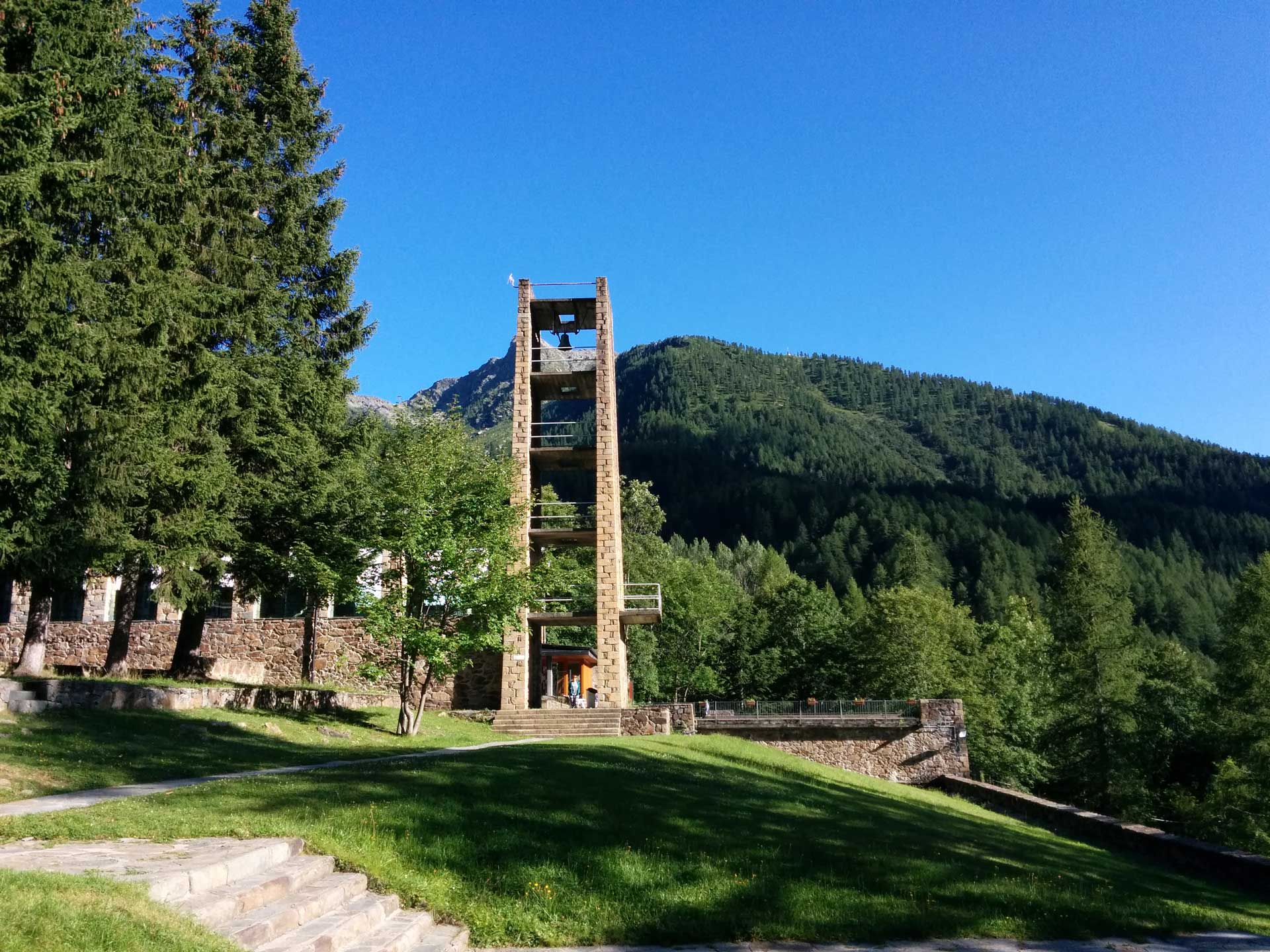
The Agape Project
Agape is an ambitious project that was born halfway through the last century from the ideas of a Waldensian pastor, Tullio Vinay. Its main goal is to be a meeting place. The founding values of Agape, i.e. reconciliation and reconstruction, are at the basis of all its activities. From the community life and volunteer work to the daily life in the centre, priority is given to being and living together in an inclusive and sustainable way.
The camps held at Agape provide a space for discussion about different subjects: current political and social topics, gender-related, spiritual and theological issues, as well as training and education.
Agape belongs to the centers and organizations of the Waldensian Church in Italy.
What’s Agape?
Agape is a meeting centre that defines itself as “ecumenical” and “international.” Its ecumenism is to be understood in a very broad sense: meeting of believers of different religions and confessions – but also non believers – who leave behind their assumptions of knowing and holding the truth.
The centre benefits from its international aspect: all groups of volunteers who live and work at Agape contain individuals from different countries. Every year Agape’s program includes a series of international camps organized by people of different international origin. The international dimension has been part of the centre since its foundation. Agape has been a place for dialogue and valorization of the differences from the beginning, a living experiment of the idea that another world is possible.
History
Agape’s history began from the need for reconciliation and togetherness that was felt not only at national but also at international level after the Second World War. The desire of peace and reconstruction inspired and led the building of the centre and the project.
In the mid 1940’s, the Second World War had left rubble and wounds behind. The idea of creating a cultural and community centre emerged from the need for rebuilding and reconciliation. The centre would have allowed people – divided by the conflict until a few months before – to meet. Already in the summer of 1946, in Prali, pastor Tullio Vinay spoke about the need to build in the Waldensian Valleys a centre that expressed the values of Christian agape and that represented the face of Christ “engraved in the rocks of our mountains” (words used in the first Agape’s manifesto). Leonardo Ricci’s project gave the centre its peculiar and modern design. From the beginning something unexpected happened: hundreds of volunteers from different countries, with different political and religious views, took part in the building. The painful consequences of the world war that ended just a few years before were overcome through the shared work and the ideal of Christ’s agape.
The young people, who in a few years were able to construct with enthusiasm and hard work the structure that is still hidden among the larches above Ghigo di Prali, were camped in the location where today you can see the new temple of Prali.
Form the 1950’s onwards, Agape has been a place of fruitful social, political and religious debate, both national and international. Many camps have been dedicated to the dialogue between Europe and Africa, the contacts with socialist countries, the Middle East issue as well as gender and sexual orientation.
Today the centre is still going along this path; however it also organizes camps for minors and training courses about the educational relationship and implements non-formal education techniques.
Spirituality
“Love never ends”
1 Corinthians 13:4-8 (NRSV)
Agape is a word that some people may find peculiar. It can be found in the New Testament where the term indicates God’s love for human beings, but elsewhere it means simply “spiritual” love.
When the apostle Paul writes, in the first letter to the Corinthians, that “love will never ends,” he means that everything is destined to reach an end, but the love of God will accompany us forever. The Agape Ecumenical Centre was inspired by this same evangelical idea. In time, it tried to be a place where this idea could be experimented and experienced through the meeting and dialogue of all faiths and opinions. Agape continues to thrive thanks to the volunteer work of those who, every year, decide to dedicate some of their time to the collective commitment that benefits this shared project.
Education
Education is one of the most important elements of Agape’s project. It is a field of constant research and confrontation for which definition this centre has been committed since the 1980s. Agape keeps questioning the education role it covers in in the activities it offers, adopting various methodologies and specially those of non-formal education, of peer-to-peer education, of participate and cooperative learning, and ludopedagogy.
find out more
Architecture
Those arriving at Agape for the first time are amazed by the fact that the centre was built in the mid 1900’s. The new and original architecture could make one think that the building is more recent.
Vinay’s dream became a reality thanks to Leonardo Ricci, one of the leading figures of modern Italian architecture in the post-Second World War era.
Agape’s modern style is more than just a reference; it is employed in an entirely original manner that brings together structures and spaces. The spaces are designed not only for the purpose of simply being “lived in,” but to also foster the many diverse relationships that spring up within them. This architecture style mirrored Ricci’s definition of space as “something that is generated from the use you make of it.”
Local materials were used, adhering to the principle of so-called “organic architecture,” while the use of alpine shapes is a reinterpretation of an idea that was put forward at that time by architects such as Mollino and Ponti. There is no central space. The main hall (“salone”) can be used for different purposes according to the time of day: it can be a meeting room, a dining hall, or an interactive space. This concept continues both conceptually and physically towards the open-air church. The main hall is a space that brings people together. It has many different potential uses, with a constantly ambiguous nature between internal and external space, which breaks with the perimeter of the walls and paths. Visual continuity is achieved thanks to the large windows.
The entire structure acts as a roof for a path that starts with the outdoor stairs and leads up to the third “casetta,” (literally small house, i.e. dormitory building) and then follows along the landscape of the mountain, thereby tracing the true element of centrality of the building: the human dimension in its community nature.

1.Tullio Vinay, Leonardo Ricci: designing the Agàpe
The lacerations of the Second World War lasted in the communities of the younger generations of Europe. At the end of the conflict, they were still frightened and disoriented and wanted to rebuild body and spirit after such a great tragedy. The creation of Agàpe or, in other words, the love of God, lies in the context of a social, spiritual and political rebirth. Agàpe, from theory, was transformed into a building with the project conceived by the Waldensian theologian and pastor Tullio Vinay and his friend and architect Leonardo Ricci.
“Therefore, Agàpe materialized as a sign and possibility for a different world from the bloody and devastated world left by the Second World War – writes Vinay – and of a different humanity from the violent and rapacious, fanatic and murderous humanity, which has manifested itself in many situations in the course of our century in many different historical and ideological contexts”. It is precisely this human aspect that guided Vinay in the development the idea of founding an ecumenical center for theological reflection in the territory of Prali, a town set in the Cottian Alps in the Upper Germanasca Valley.
“Agàpe manifested itself as a vocation before actually becoming a project – writes Paolo Ricca – that is, as a mandatory call that cannot be evaded, as a divine intimation that bends the human will and drags it into an adventure of faith […]”. The project saw the participation of volunteers seeking a new spiritual dimension by putting themselves at the service of the community, building something to share that goes beyond faith. To achieve this Vinay entrusted the task of building Agàpe to his friend Leo Ricci, a Roman architect who was working in Florence. In June 1947, the first group of forty young volunteers began to arrive from all over Italy and later on, many others from all over the world. In just four years, despite enormous logistic, procurement and money difficulties, they were able to complete the work.
Agàpe was inaugurated on August 12th 1951!
Today we are celebrating seventy years since its foundation, and with this exhibition, curated by Emanuele Piccardo and Andrea Sbaffi, we retrace the history of Agàpe. We link Vinay’s thinking, the landscape and the architecture of Ricci as a homogeneous unicum: a testimony of the spiritual reflection that is still relevant today. Emanuele Piccardo, Andrea Sbaffi.
2. The postwar period and reconciliation
The idea that sparked off the conception of Agàpe, stems from the great turmoil that swept Europe at the end of the Second World War. The demand for reconstruction concerned not just the land and the cities devastated by the conflict, but also principally involved the social fabric and the delicate system of relations of the time.
In this context, the younger generations and their “thirst for novelty”, as defined by Vinay himself, played a fundamental role. This triggering force could oppose the tragic experience of the war that had just ended. Many young people of the Waldensian Church, but not only, had participated in the Resistance or had suffered deportation and confinement. Due to the war, youth organizations had to interrupt their relations with international organizations that mostly belonged to the nations that had fought the Nazi-Fascist regimes. Agàpe therefore became a solid vocation, turning into a call for young people from all over the world to roll up their sleeves and build a physical place to meet, and most importantly, a space for discussion, elaboration and concrete sharing of a “new” model for society and interpersonal relationships.
3. Tullio and Leo
“Building on this earth – writes Ricci – is building in the kingdom of heaven. The walls of stone and lime that we raise are a laborious and loving conquest, and will be destroyed. However, we will find them together again after our earthly death. Dear Vinay – continues the architect – the article you asked of me has turned into a letter addressed to you, beloved friend. You are so much part of my life and because with you, I feel that human brotherhood has been made into an real object, a situation we have been trying in vain to achieve with all the people around us, be they murderers or prostitutes because of our weakness.”
This testifies the affection between Vinay and Ricci and the sharing of the same ideal of community: the former through spiritual and political thought, the latter through architectural research.
4. The project
“Building for Agàpe is knowing that the soil on which the seed is sown is fertile; that it is continuously plowed and leavened by men like you [Vinay]; that the harvesters are young people who await and need the fruit that comes from the earth. Wonderful and joyful thing. For Agàpe, all the rest has no value. The architect’s pride no longer exists. There is a complete trust. I don’t have the means I need, there is a lack of materials that I would like, I do not have specialized workers […] Yet, it is the first time that I feel I am building for a true, real thing. This is why I feel that while we may build fitfully and with errors, but we are doing our best and the result will be beautiful because it is the outcome of something loved by everyone”. Leo Ricci
Agàpe was the first work of Leonardo Ricci, and he immediately demonstrated his ability to create tension between the inside and the outside. Light shapes the interiors and he draws vertical views of the surrounding mountains between the solidity of the stone partitions and the emptiness of the enormous windows. Agàpe is, above all, the embodiment of the spiritual and political thought expressed by Vinay: to represent the needs of the young generation that came out of the war bewildered and disoriented, eager to take on the future. The participation of young volunteers, coming from all over the world and belonging to different religious confessions, demonstrates the universality of Vinay’s work being carried out by Ricci in order to create community.
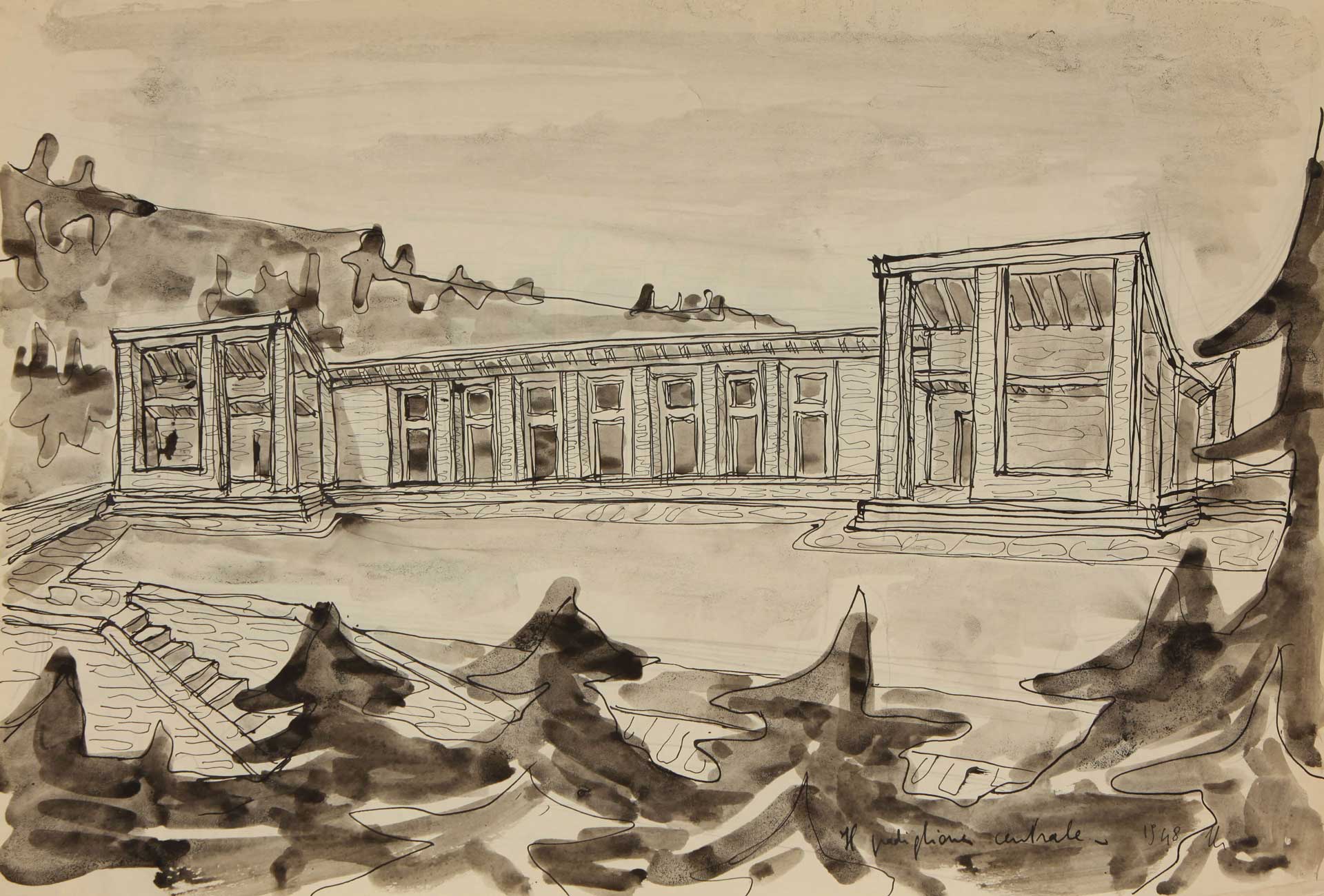
The Casa Studio Ricci Archive preserved the sketches of the initial phase that highlight the cherished relationship with the landscape.
Ricci writes: “Outside and inside Agàpe is an outflow from and a return to the community. There is space for a solitary individual, for a small group of chosen individuals, for the family, for the whole community”.
In Europe, the publication of the works of Frank Lloyd Wright influenced many Italian architects. A different version of organic architecture was created, one of which Ricci was one of the main interpreters. Thus, Ricci composed an organism that “begins its life by adhering to the nature that surrounds it”. This is emphasized by Agape being rooted in the earth through a horizontal distribution of functions, albeit in a vertical, orographic context. This attitude constitutes the original element of Ricci’s architectural poetics. The walking paths that connect the space intended as the meeting room and the three houses where the campers stay, add to that poetry, as does drawing the shape of the landscape at ground level. The use of poor materials (stone, glass, wood) defines the essential character of the architecture in Prali, that shows up again in Riesi at the Monte degli Ulivi Village.
The drawings from the Ricci Collection of the CSAC (Studies and Archive Center of Communication in the University of Parma) represent the first version of the project that would be modified by Ricci himself during the construction site.
5. The construction site
The decision to build Agàpe was made during the youth camp held in August 1946 in Prali. In the same year, Vinay founded the magazine ‘Gioventù Evangelica’ [Evangelical Youth], The aim was to give voice to the youth movement, which was hopeful for the future that was slowly forming and taking root. The process that led to the creation of the community of Agàpe starts with raising funds and resorting to voluntary work, as Vinay’s words once again testify:
“[…] a youth union has promised us miners to blow up rocks and to give us stones. Others have pledged electricians and others have given window frames and locks … the biggest offers were made by the young people of Perrero- Maniglia who engaged in the manufacturing of 25 tonnes of lime, and by the young people of Prali, Fontane and Rodoretto, who have cut down a considerable number of larches (donated by the Municipality) and transported the timber to the construction site “.
At the beginning, in June 1947, the first group consisted of forty young people. International volunteers joined later on thanks to the work carried out by Vinay of disseminating the project in the many assemblies, both inside and outside the Waldensian Church. In Prali, the first difficulty was to identify the site. It had to be sunny and of a certain size to contain the ‘village’. It would not be too close to the other houses in the town. The Crô area was thus identified at 1500 meters above sea level, with a panoramic view of the mountains.
The first planning idea came from the Waldensian engineer Nino Messina and Ricci offered his contribution later on. The tasks were shared: Messina was appointed to the structural part and the direction of the construction site, Ricci to the architectural design.
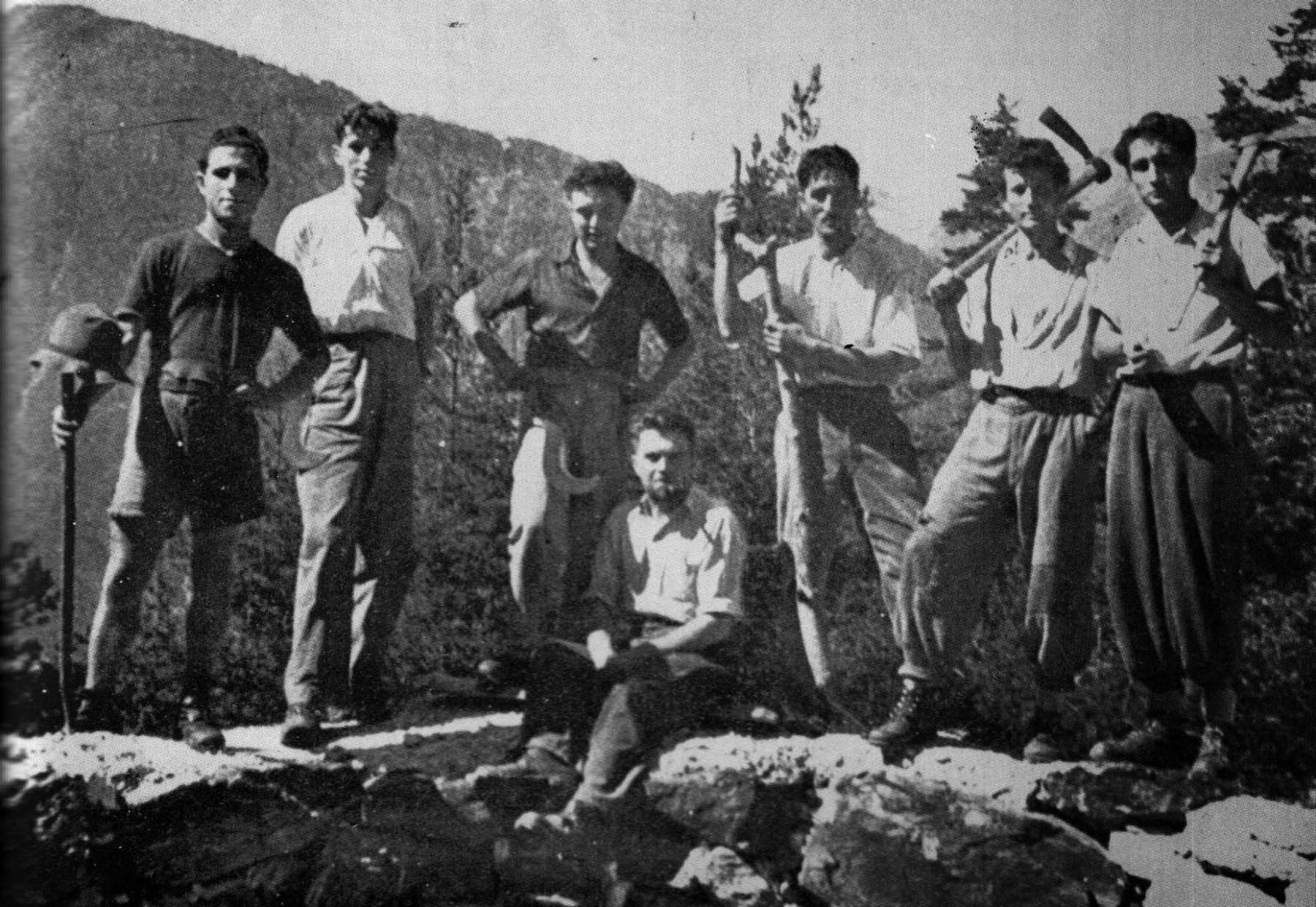
The pictures of the Waldensian Photographic Archive portray how both adults and adolescents, both women and men participated with one goal: to build the community.
How to donate to Agape
Agape lives thanks to the support of all of us. If you wish to support us make a donation!
via bank transfer: Our bank account at Banca Popolare Etica
Account holder’s name: Agape Centro Ecumenico
IBAN IT72A0501801000000000110460
BIC CCRTIT2T84A
ATTENTION: the following bank details are NOT to be used for the payment of registration fees or camp fees!


