
Qué son los Campamentos de Agape?
Los campamentos que se realizan en Agape ofrecen un espacio para la discusión y el intercambio constructivo, y tienen una duración de una semana hasta un máximo de diez días. Existen tres tipos principales de campamentos: campamentos para menores, campamentos de género y campamentos internacionales. Cada año, un campamento se centra en un tema actual diferente, que se desarrolla a través de diversas herramientas: actividades de educación no formal, debates, sesiones plenarias, discusiones en grupo, conferencias de expertos, talleres, juegos de simulación y más.
Los campamentos también representan una oportunidad para pasar tiempo rodeado de la naturaleza de Prali, conocer personas provenientes de distintos países y con diferentes antecedentes, divertirse y descansar. Participar en un campamento en Agape significa formar parte de la vida comunitaria, caracterizada por compartir espacios y la vida cotidiana, así como experiencias personales.
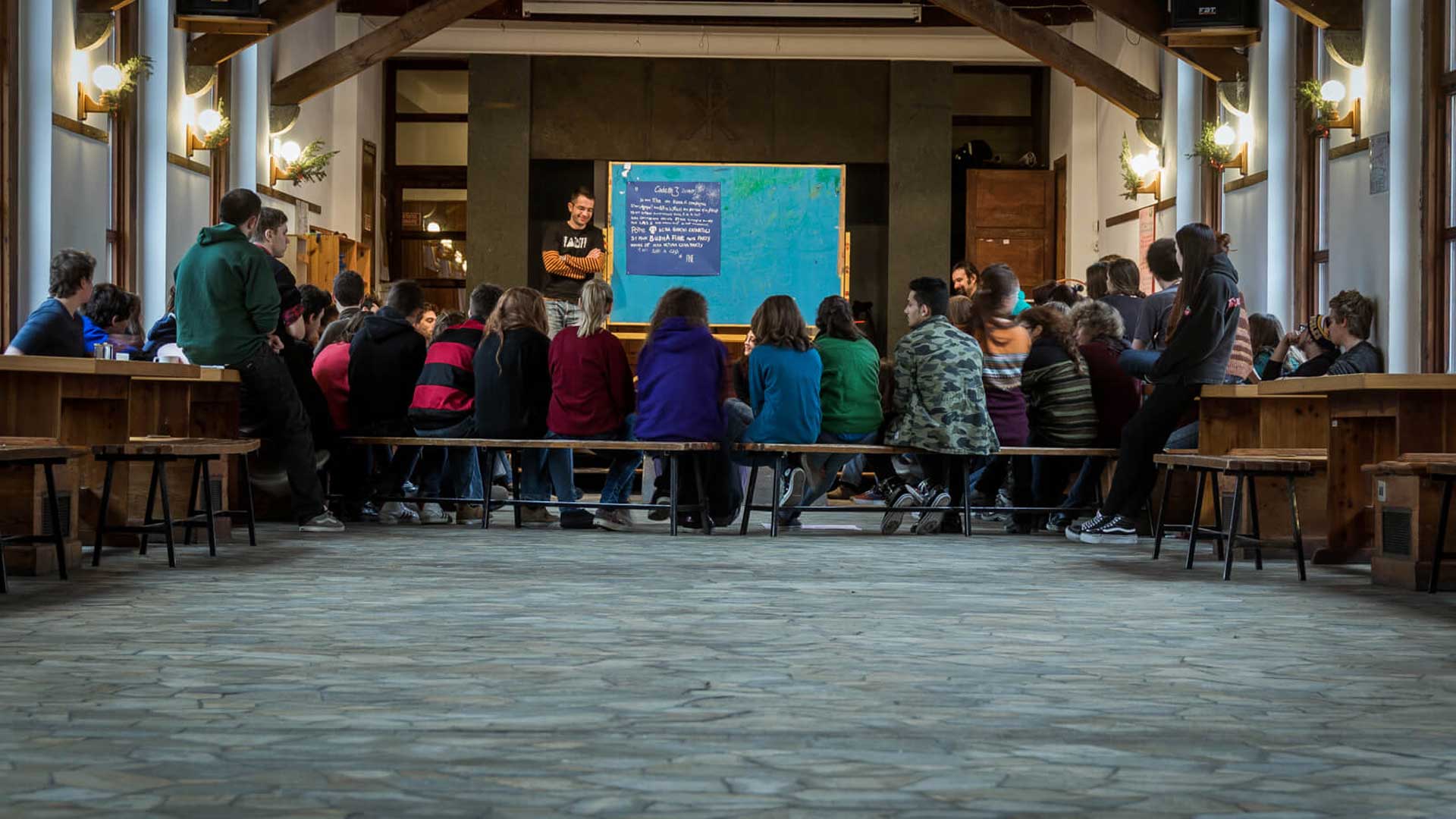
Programa
2025
| 26 Dic - 1 Ene | Cadetti/e 3 | Sguardo oltre i muri |
2026
Horario Diario
- Despertar
de 8:00 a 8:30 – Desayuno -
Actividades de la mañana
Pausa a media mañana: el bar está abierto -
Almuerzo
a las 12:30 o 13:00, seguido de un breve descanso -
Actividades de la tarde
Pausa a media tarde: el bar está abierto -
Cena
a las 19:30 o 20:00, seguida de un breve descanso -
Actividades de la noche
terminan alrededor de las 23:00; el bar está abierto
Los campamentos en Agape siempre siguen el mismo orden de actividades, con algunas posibles variaciones en el horario.
Las actividades del campamento siguen un hilo conductor y analizan el tema central desde diferentes puntos de vista. Cada actividad no es un fin en sí misma, sino que transmite un mensaje y contribuye al desarrollo del tema principal. Existen diferentes tipos de actividades adaptadas a los distintos participantes del campamento: los campamentos para menores utilizan juegos y actividades que transmiten los temas de manera más implícita, mientras que los campamentos para adultos ofrecen debates, conferencias o presentaciones. Todos los campamentos utilizan técnicas de educación no formal: incluso los adultos participan en actividades como juegos de simulación o talleres creativos que los desafían de distintas maneras.
Por la noche se realizan actividades más recreativas, como ver películas, cantar, bailar y juegos de convivencia. Todos los campamentos incluyen una caminata por las montañas de Prali, que a menudo termina con una fogata al regresar a Agape.
Las comidas se realizan en un espacio común. Todos comen juntos en mesas para diez personas y comparten los alimentos. El Resident Group planifica el menú semanal intentando incluir productos de temporada y, cuando es posible, de proximidad (0 km). La carne se limita a una vez cada dos días.
Agape ofrece a menudo un momento de cierre de los campamentos que hace referencia a los orígenes cristianos del Centro, con un enfoque más espiritual y religioso. No es obligatorio participar, pero es importante tener en cuenta que forma parte integral de la historia y la vida de Agape.
Cada campamento finaliza con una fiesta de despedida para celebrar los momentos compartidos, que también representa una oportunidad para compartir los resultados con el Resident Group y el Workcamp que hicieron posible el campamento.
Organización
Cada campamento cuenta con un comité de planificación, el “staff”, formado por voluntarios que son expertos en el tema y/o en los métodos para preparar un campamento. El grupo de staff puede estar compuesto por un mínimo de cinco miembros y un máximo de doce. Cada staff debe incluir un miembro del Resident Group para garantizar la comunicación y la organización logística con el Centro, y para asegurar que el campamento se mantenga fiel al espíritu de Agape. A todos los que estén interesados en unirse a un staff por primera vez se les solicita participar en el Campamento de Formación y Educación que Agape organiza cada año durante el invierno.
Agape procura ofrecer a todos los grupos de staff las herramientas necesarias para posibilitar el mejor campamento posible: se presta atención al tipo de participantes, los temas, el trabajo en equipo y la dinámica interna del staff. Los grupos de staff reciben formación continua gracias a las relaciones horizontales entre sus miembros, quienes, durante las reuniones de preparación, comparten sus habilidades y conocimientos adquiridos en experiencias previas en otros staffs. El Staff Council es un grupo de personas disponible para las necesidades de formación del staff.
Si deseas unirte a un staff, haz clic aquí.
Participación
Los participantes deben estar interesados en el tema del campamento y estar dispuestos a formar parte de la vida comunitaria y del trabajo del Centro. Formar parte de una comunidad constituye la base para un intercambio y encuentro significativo. Es importante tener en cuenta que participar en un campamento en Agape implica ingresar a una dimensión comunitaria, donde los individuos deben estar preparados para ser desafiados, para compartir y para aceptarse mutuamente.
Al inicio de la historia de Agape, el Centro era frecuentado principalmente por protestantes; pronto se sumaron católicos y no creyentes. Hoy en día, muchas personas de diversos orígenes sociales y culturales y de distintas espiritualidades, que también difieren en creencias políticas, así como en identidades de género y sexuales, asisten a Agape. Los participantes deben ser respetuosos al aceptar y acoger ideas diferentes y estar dispuestos a intercambios y discusiones.
Solicitudes
Las solicitudes para los campamentos están abiertas a partir de las siguientes fechas:
- 15 de octubre para los campamentos de invierno
- 15 de enero para los campamentos de primavera
- 15 de marzo para los campamentos de verano
Es posible inscribirse en los campamentos a través de este sitio web, rellenando el formulario que se encuentra al final de la página del campamento. Recibirá un correo electrónico automático cuando envíe la inscripción. Si tiene algún problema, puede ponerse en contacto con nosotros:
- Por teléfono: +39 0121 807514
- Por correo electrónico: [email protected]
FAQs
How are the camp fees determined?
At Agape, the cost of a camp covers essentially the stay and the cost of the programme carried out.
- The cost of the stay includes food and accommodation, lodging and heating; however, this does not cover the costs of maintaining the structure, for that we currently have to rely on gifts.
- The cost of the programme includes materials used for the activities and the organisazion and logistics for the staff’s, workshop leaders and speakers travel expenses, in most cases at Agape also they are volunteers!
These expenses are covered by paying fees 1 or 0.
The fee 2 is a way of supporting Agape’s project for those who can afford it: it includes a gift for maintaining the structure and also a solidarity contribution: not all people, in fact, can afford to come to Agape; to allow everyone to come, there is a reduced fee that does not cover entirely Agape’s costs.
You can choose the fee according to your income; the info graphic (which we will insert shortly) can give you an idea, even if – like all simple diagrams – it cannot map all the possible situations.
Agape belongs to those who come to be part of it, and it is dependent on the contributions of those who are part of it – there is no “Agape” outside the community that maintains it. Therefore, coming to Agape it is not paying for a service but contributing to a common project: Agape has many volunteers who donate their time and commitment.
With the fee system, this community tries to keep a place accessible and linked to diversity without impeding anyone’s participation. As any solidarity system can work only when everyone is willing to contribute according to their own strength. We don’t want to control who does it and how it does it, so we don’t ask for any justification for your choice of fee.
If you need financial support beyond the reduced fee you can contact [email protected].
Camp Scholarships and other forms of support
In Agape, we have always tried to make sure that participants do not have to renounce participating in a camp for economic reasons. This is why we have different fees based on the concept of solidarity, so as to support Agape’s planning and activities according to your means. Feel free to choose any fee, and please keep in mind that the activities of Agape depend on your contribution.
If the lowest fee is too expensive for you, you may apply for a scholarship. Such scholarships allow children in foster care (if the State does not provide funds for this kind of activity) and people belonging to associations of political refugees to participate. Overall, we aim at supporting families in need, those who enroll many minors in different camps, students or unemployed people, people with a precarious job.
The scholarship fund is not unlimited, and we want to make sure that as many people as possible can access it if they need to. For this reason, we can only give you an answer once we know the number and types of applications.
Applying for a camp scholarship is very straightforward. You can send an email to [email protected] with your name, surname, camp you are enrolled in and we will reply to define details of the scholarship.
How does the waiting list work?
Applications
Applications for Agape camps open in advance on set dates that are well-known to those who come to the Center regularly:
- Spring camps: 15 January
- Summer camps: 15 March
- Winter camps: 15 October
Applications are open until the day before the camp. In case the number of available spots is reached, we will create a waiting list.
Spots
Each camp offers around 60 spots, a percentage of which is dedicated to specific categories which are divided as follows:
Around 16% of spots go to those who have never taken part in any camp;
The following percentages apply to camps for minors:
- 5% of spots go to children in foster care;
- 5% of spots go to Agape’s partnership projects;
Draw procedure
If, at the end of the first day of enrolment, the number of applications for a camp exceeds the available spots for one or more of the abovementioned categories, we will draw with the following procedure:
If you could not participate in the same camp the previous year and you sent the application on the first day, you have the right to take part in the camp without being drawn;
If two people want to attend a camp together, they should both write the name of the other person on the form because draw will take place by drawing pairs of names. People who haven’t expressed a preference will be paired randomly;
The pairs are drawn until there are no more available spots and then the waiting list is made.
Timeline for specific categories
The spots for people who have never taken part in an Agape camp are kept on a specific waiting list, which will be valid until some weeks before the beginning of the camp. Specifically:
- Spring camps: until the end of February;
- Summer camps: until mid-May;
- Winter camp: until the end of November.
Once the deadline has expired, the spots will be given to the first names on the waiting list.
The spots for other specific categories (foster care and specific projects) are kept until a week before the beginning of the camp. After this deadline, they are given to the first names on the general waiting list.
How can I help during the camps?
What do I need to know before coming to Agape?
Useful information before you come to Agape
Participating in a camp at Agape means to take a part in the community life of the Center for a week. Those who come to Agape, whether to take part in a camp, in a study visit or to spend some time off, are invited to respect some rules.
- Participants accept taking part in the camp life and its educational activities entirely.
- In case you leave in advance, fees won’t be reimbursed, not even partially.
- Guests have to bring a valid ID.
- We ask each participant to help setting the table and drying dishes, both because it is a necessary support and because to us, this is a way of sharing our work.
- Agape is not responsible for accidents or damage happening during the camps in case of violation of internal rules. The Center is responsible for participants’ cash and belongings only if these are given to Agape to be kept in a safe. Agape will ask for the refund of any damage caused by the guests.
- During winter time, it snows in Agape (which is at 1,600 meters a.s.l.). You will need to bring warm and comfortable clothes and shoes.
- The rooms have three or four beds each and bathrooms are on the same floor. There are no single or double rooms. Agape provides sheets and blankets, but guests are required to bring their own towels.
- Due to health and safety rules, it is not allowed to bring dogs or other animals to Agape.
Agape cannot provide medicines. Since the pharmacy in Prali is not open every day, you will need to bring the medicine you need with you.
Donar a Agape
Agape vive de la participacion y el apoyo de tods nosotrs. Si quieres apoyarnos economicamente puedes hacer una donacion!
Transferencia bancaria:: Cuenta Corriente bancaria - Banca Popolare Etica
Dirigido al Agape Centro Ecumenico
IBAN IT72A0501801000000000110460
ATENCION: Estrictamente, no debe usarse como pago del deposito o cuota de los Campamentos!


